A profile view of a lone male hiker with a backpack and trekking poles standing on a rugged mountain peak. He looks out across a vast, endless sea of clouds that fills a mountain valley at sunrise, with a powerful golden sun low on the horizon casting warm light. The sky is golden and cool blue.

Depression is often described as a heavy blanket that smothers the soul, dulling our joy, our drive, and our desire for connection. Over my 15 years of clinical practice as an Ayurvedic practitioner, intimacy coach, and hypnotherapist, I have sat with countless individuals whose lives and relationships have been fractured by this invisible weight.

In the modern medical paradigm, depression is typically viewed purely as a neurochemical imbalance. While neurotransmitters are certainly involved, Ayurveda offers a much more profound, systemic lens. We view depression not just as a disease of the brain, but as a crisis of the Manas (mind), the Doshas (bio-energies), and the Ojas (vital essence).

When we combine this ancient, holistic wisdom with modern hypnotherapy and intimacy coaching, the results are deeply transformative. Let’s explore how Ayurveda heals the depressed mind, restores relational harmony, and brings the light back to life.

The Ayurvedic Anatomy of Depression

To understand depression in Ayurveda, we must look at the classical texts. Thousands of years ago, the sages understood the devastating physical toll of mental despair.

In the Charaka Samhita, the foundational text of Ayurvedic medicine, there is a profound Sutra:

“विषादो रोगवर्धनानाम्” (Vishado rogavardhananam)

Charaka Samhita, Sutrasthana 25/40

Translation: “Grief and despair (Vishada) are the foremost among all factors that aggravate disease.”

"Ayurvedic Shirodhara therapy for depression: Warm medicated oil being poured onto a woman's forehead to calm the mind, relieve anxiety, and soothe the nervous system."

“Shirodhara is more than a relaxation technique; it is a profound clinical intervention. By continuously pouring warm, medicated oil over the Ajna Chakra (third eye), we directly pacify erratic Prana Vata, cooling an overworked nervous system and gently washing away the heavy fog of depression.”

Ayurveda categorizes depression as a Mano Vikara (disease of the mind) rooted in an imbalance of the psychological qualities of Rajas (agitation/movement) a

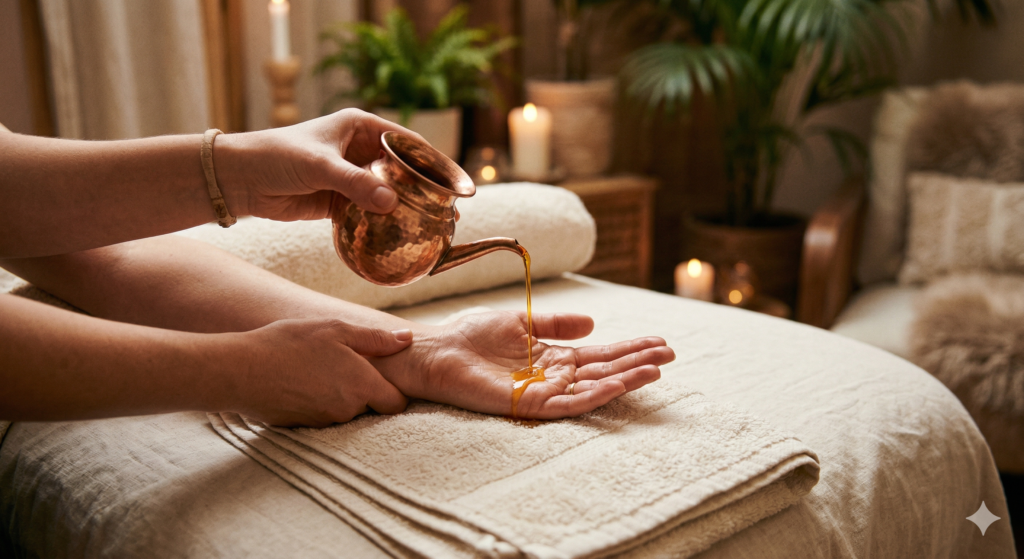
"Ayurvedic touch therapy for depression and intimacy: A practitioner gently pouring warm medicated oil from a copper pitcher into a patient's open hand to restore nervous system balance."

Grounding erratic Prana Vata begins at the skin. The simple, profound act of receiving warm herbal oil helps dissolve the cold, heavy inertia of depression, restoring the flow of Ojas (vitality) and bringing warmth back to the body.

nd Tamas (darkness/inertia). When Tamas dominates, it clouds the mind, leading to lethargy, hopelessness, and disconnection.

Physiologically, depression involves three distinct doshic imbalances:

  1. Tarpaka Kapha Stagnation: This sub-dosha governs the white matter of the brain and emotional contentment. When stagnant, it causes the classic heavy, unmotivated, “can’t get out of bed” type of depression.
  2. Sadhaka Pitta Burnout: Located in the heart and brain, this governs joy, drive, and the processing of emotions. When depleted, we lose our passion, our libido, and our sense of purpose.
  3. Prana Vata Aggravation: Governing the nervous system, erratic Vata creates the anxious, restless, and insomniac facets of depression.

Bridging Ancient Wisdom with Modern Intimacy & Hypnotherapy

Ayurveda prescribes Sattvavajaya Chikitsa—which translates to “bringing the mind back to its pure, true state” (Sattva). In my clinic, I facilitate this through Hypnotherapy.

Hypnotherapy is essentially modern Sattvavajaya. While Ayurvedic herbs heal the physical neurochemistry, hypnotherapy bypasses the critical, conscious mind to rewrite the deep, Tamasic (dark/negative) subconscious loops that keep a person anchored in despair.

Furthermore, depression is an intimacy killer. Without Sadhaka Pitta (emotional drive) and Ojas (vitality), libido flatlines. The erotic mind, which Ayurveda calls Sankalpa (intention/imagination), cannot function when the nervous system feels unsafe or exhausted. This is where clinical intimacy coaching becomes vital—we cannot just treat the depression; we must also consciously rebuild the patient’s capacity for touch, pleasure, and vulnerability.

Clinical Case Example: Reawakening the Drive

To illustrate this, let me share an anonymized case from my clinic. “Rajat,” a 38-year-old male, came to me on the brink of divorce. He had been suffering from moderate depression for two years. His symptoms were classic: chronic fatigue, emotional numbness, and severe erectile dysfunction. He felt immense shame, and his wife felt completely rejected. Modern antidepressants had numbed his anxiety but completely obliterated whatever libido he had left.

The Protocol:

I did not treat Rajat’s erectile dysfunction directly at first; I treated his Vishada (despair) and depleted Ojas.

  • Herbal Intervention: I placed him on a protocol featuring Ashwagandha (Withania somnifera) to stabilize his Vata and rebuild his resilience, alongside Brahmi (Bacopa monnieri) to clear the mental fog.
  • Hypnotherapy: We conducted weekly hypnotherapy sessions to address his deep-seated feelings of inadequacy and performance anxiety. We worked on reframing his subconscious beliefs about masculinity and success, transitioning his mind from a state of Tamas (fear/avoidance) to Sattva (clarity/acceptance).
  • Intimacy Coaching: I gave Rajat and his wife homework rooted in Ayurvedic Sparshana (touch therapy) mixed with modern sensate focus. We removed the goal of intercourse entirely, focusing only on slow, non-demand touch using warm, medicated oils. This bypassed his performance anxiety and allowed his nervous system to associate his wife’s touch with safety and pleasure, rather than pressure.

The Result: Within eight weeks, Rajat’s energy levels returned. By month three, the hypnotherapy had cleared his subconscious blocks, his mood had stabilized, and natural, unforced intimacy returned to his marriage.

What Modern Science Says

This holistic approach is not just ancient theory; it is heavily backed by modern clinical research. The herbs utilized in Ayurveda are profound adaptogens.

For instance, a landmark double-blind, randomized, placebo-controlled study published in the prestigious Indian Journal of Psychological Medicine investigated the clinical efficacy of Ashwagandha root extract on stress and anxiety—major precursors and companions to depression.

The researchers found that participants taking high-concentration Ashwagandha root extract exhibited a highly significant reduction in stress assessment scores and, crucially, a substantial reduction in serum cortisol levels compared to the placebo group. (Chandrasekhar, K., Kapoor, J., & Anishetty, S., 2012). By medically lowering cortisol, we reduce the systemic inflammation that modern neuroscience now links directly to depressive disorders. We are quite literally cooling the overheated nervous system.

A Holistic Protocol for Lifting the Fog

If you are currently navigating the heavy waters of depression, healing requires a multi-pronged approach:

  1. Regulate the Routine (Dinacharya): Depression thrives in chaos and stagnation. Regulating your sleep and wake cycles balances Prana Vata. Wake up before 7:00 AM to avoid the heavy Kapha time of day.
  2. Botanical Support: Under the guidance of a practitioner, herbs like Jatamansi, Brahmi, and Ashwagandha can gently naturally repair the nervous system without the emotional blunting often associated with pharmaceuticals.
  3. Reprogram the Subconscious: Seek therapies like Hypnotherapy to clear out the Tamasic emotional residue. You cannot out-think a subconscious belief; it must be reprogrammed at the source.
  4. Gentle Reconnection: If depression has impacted your relationship, remove the pressure of sexual performance. Focus on emotional intimacy, eye contact, and gentle, loving touch to slowly rebuild your Ojas and relationship safety.

Final Thoughts

Depression is not a life sentence, nor is it a personal failure. As stated in the Ashtanga Hridayam, health is the perfect balance of the doshas, the tissues, the digestive fire, and a blissful state of mind, soul, and senses.

Through the strategic integration of Ayurvedic medicine, subconscious reprogramming, and conscious intimacy practices, we can do more than just manage depression—we can heal it at its root.


If you are struggling with low mood, lack of drive, or intimacy challenges, you don’t have to navigate it alone. Reach out to schedule a consultation, and let’s design a holistic roadmap back to your most vibrant, passionate self.