

Have you ever felt the rest of the world simply blur into a haze? This isn’t a loss of control—it’s a natural state of everyday hypnosis, where profound relaxation meets razor-sharp internal focus.
You likely spent several hours today in a trance. If that sounds like the opening line of a psychological thriller, consider the reality of your neural architecture: our brains are not designed to maintain a sharp, clinical focus on the external world for sixteen hours straight. Instead, we are wired for deep-dives, often submerging so far beneath the surface of a task or a thought that the external world goes quiet.
When most people hear the word “hypnosis,” they envision the theatrical debris of Hollywood: a swinging pocket watch, a sinister command to bark like a dog, or a total surrender of the will. This trope suggests that hypnosis is an external force—something done to you. In reality, hypnosis is a natural, common state of altered consciousness that you navigate daily, often without even realizing you’ve left the shore of “normal” awareness.
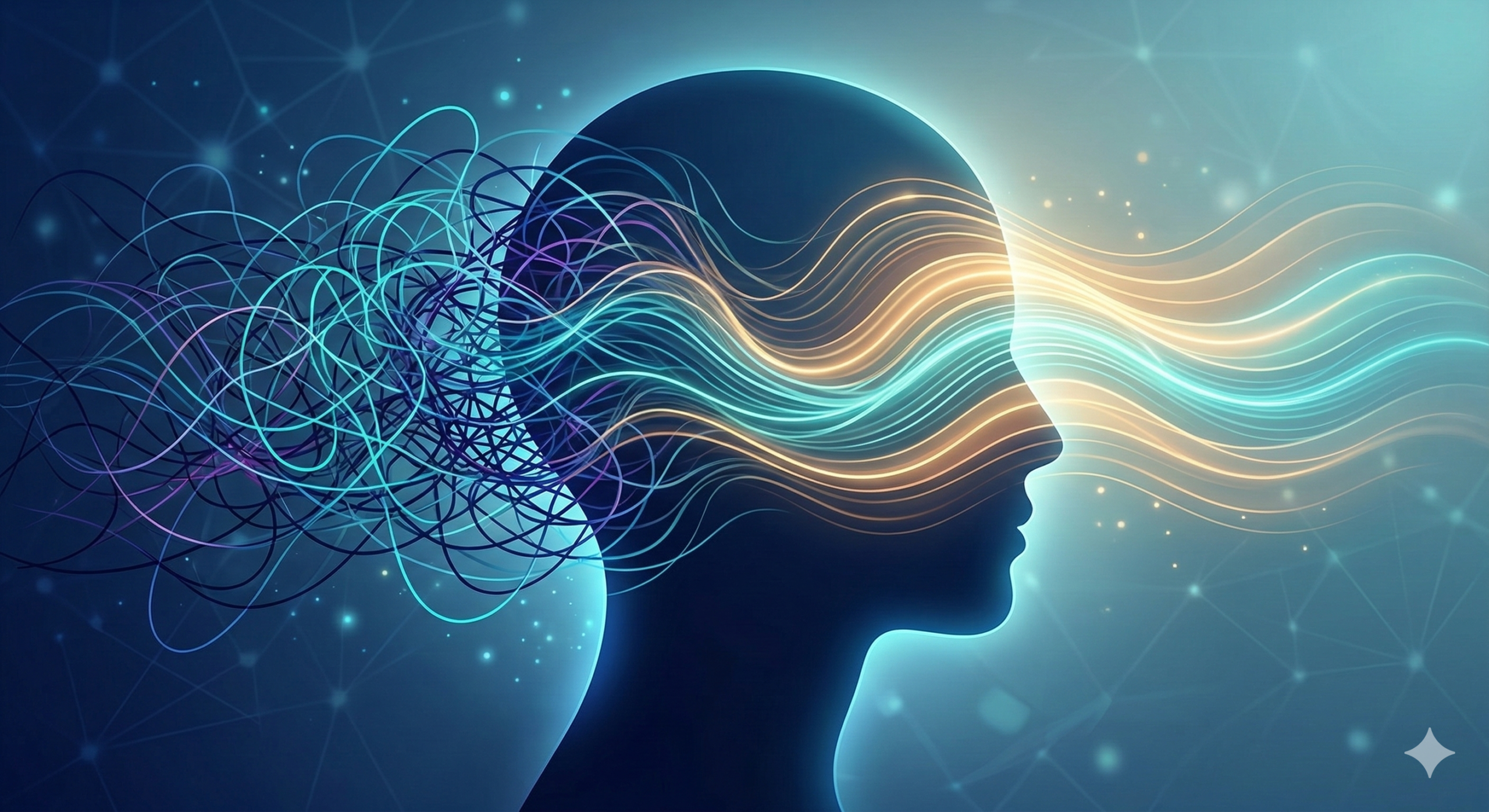
During a trance, the chaotic static of external distractions smooths out into highly efficient, razor-sharp internal focus.
It’s a Natural State, Not a Magic Trick
Strip away the stage lights, and you’ll find that hypnosis is a fundamental mental utility. It is characterized by a specific neurological intersection: profound relaxation paired with razor-sharp internal focus.
“Hypnosis can be described as an altered state of consciousness where a person feels very relaxed and focused, making them more receptive to suggestions.”
Far from being “unconscious,” a person in this state is simply experiencing a shift in the ratio of their attention. It is a normal, healthy mental state—a biological optimization that allows us to process information with high efficiency.
1. The “Autopilot” of the Commute (Highway Hypnosis)
We’ve all experienced the “missing miles”—that jarring moment when you pull into your driveway and realize you have no active memory of the last ten minutes of the drive. This is “highway hypnosis,” a classic demonstration of the brain’s efficiency.
When we navigate a familiar route, our procedural memory—governed by the basal ganglia—takes the wheel. Because the task is so repetitive, the prefrontal cortex (the seat of our conscious decision-making) is essentially “released” from active duty. You are still driving safely, but you have entered a trance where your conscious mind is free to drift, leaving the “autopilot” to handle the mechanics of the road. Your awareness of the journey’s details fades as you sink into an internal narrative.

The “missing miles” of a familiar commute aren’t a lapse in attention, but a classic example of your brain’s procedural memory taking the wheel.
2. The Deep Immersion of “Flow”
Whether you are crushing a deadline, painting a canvas, or sprinting through the final mile of a run, you have likely hit “the zone.” In psychology, we call this selective attention, and it is indistinguishable from a hypnotic trance.
- Professional Absorption: When deep in a project or exam prep, your concentration can become so absolute that you ignore all external stimuli.
- Athletic and Creative Trance: Athletes and artists frequently report a “oneness” with their movements or their medium. In these moments, you become so absorbed in your performance that the world—and even the passage of time—simply vanishes.
This state is so profound that, according to the source context, you might not even notice someone calling your name. Your brain has effectively shuttered the windows to the outside world to devote 100% of its processing power to the task at hand.

Have you ever been so deeply immersed in a project or a hobby that the room around you seemed to fade away? This is the creative trance of the flow state.